
On behalf of Bee Developments Norwich Limited, Norse Group prepared an application and appeal for six dwellings in Mileham
Case study
Housing development planning appeal
Client: Bee Developments Norwich Limited
Project overview
The challenge
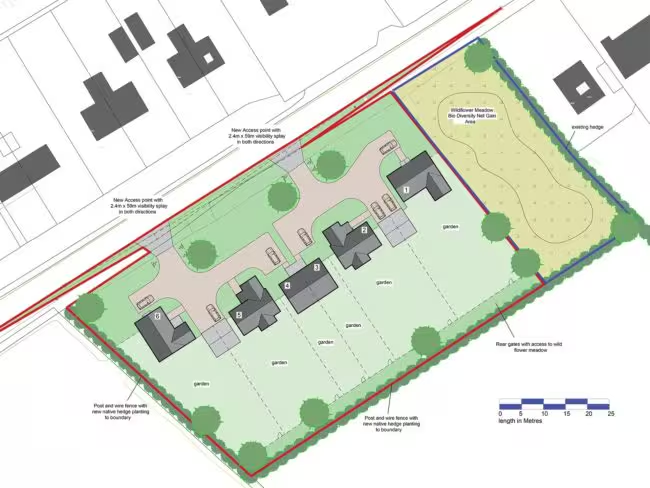
On behalf of Bee Developments Norwich Limited, Norse Group prepared an application and appeal for six dwellings at land off Litcham Road in Mileham, including two affordable homes, on a site well related to an existing village settlement. The application sought to respond to concerns identified through the consideration of a similar proposal, which had previously been refused and subsequently dismissed at appeal.
In September 2025, the Local Authority refused outline planning permission, taking the view that the proposal conflicted with settlement boundary policies, would not constitute infilling or rounding off, harmed a visually important gap, and represented an unsustainable location for housing.
An appeal was submitted by our planning consultancy team to demonstrate why circumstances had materially changed and why permission should now be granted.
Our approach
Following a review of the planning circumstances, it was recommended that an appeal be pursued in light of changes to the policy context and housing land supply position. Acting on behalf of the client, a comprehensive appeal was prepared and submitted which focused on:
- Changes in national planning policy
- The Local Authority’s housing land supply position
- The provision of six dwellings, including two affordable homes
- Detailed evidence on landscape and visual effects
- Delivery of biodiversity enhancements and biodiversity net gain
- Securing affordable housing and off-site biodiversity net gain through a completed legal agreement
- Demonstrating that any harm arising from the development would not significantly and demonstrably outweigh the benefits
Following national policy change in August 2026, a further case had to be presented regarding how the benefits of granting planning permission would not be substantially outweighed by any adverse effects.
A key part of the strategy was recognising that the proposal did not fully comply with Policy HOU05 and focusing instead on the planning balance and the application of national policy.
Housing land supply
A key consideration was the Local Authority’s housing land supply position, which stood below the 5-year target at 2.82 years during the appeal process.
This was a key material consideration in the appeal case and meant that whilst the proposal conflicted with the development plan, the ‘tilted balance’ needed to be applied to the assessment to determine whether any harm arising from the development would significantly and demonstrably outweigh the benefits.
During the appeal determination, the National Planning Policy Framework was updated (August 2026) which removed the titled balance application and changed the way in which the proposal needed to be assessed. A statement was submitted to the Inspector, justifying why planning permission should be granted when the proposal is assessed against the new National Decision-Making Policy S5.
The Inspector agreed that: “the benefits of granting planning permission would not be substantially outweighed by any adverse effects when assessed against the national decision-making policies of the Framework taken as a whole. Accordingly, the proposal satisfies the requirements of NDMP5(j)(i). In these circumstances, the Framework indicates that planning permission should be granted.”
Affordable housing and sustainable transport
Although only six homes were proposed and there was no affordable housing requirement, the scheme delivered two affordable dwellings. It was recommended to the client to secure these affordable homes via legal agreement and submit as part of the appeal, so that more weight could be attached to them.
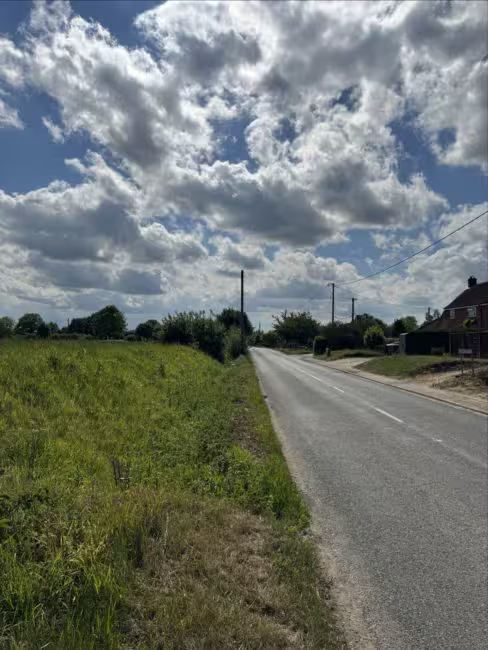
The appeal considered previous concerns around accessibility to local services, public transport provision and the extent to which future residents would rely on private car travel.
The Inspector determined that “the proposal is modest in scale and could be accommodated by the infrastructure and services available locally. In addition, a bus stop is situated close to the appeal site. Whilst there is no formal pedestrian crossing, traffic levels observed during my site visit were relatively low, and I am satisfied that pedestrians would be able to access the bus stop without undue difficulty. These factors satisfy the key requirements of Policy S5(1)(j)(i).”

Character, landscape and ecology
The Local Authority’s assessment identified concerns regarding the effect of the development on an important gap within the village and its contribution to local character. Landscape evidence and the proposed design were considered during the appeal process, demonstrating that substantial separation would remain and the village’s defining settlement pattern would continue to be evident. The Inspector ultimately found only moderate landscape harm at a localised scale.
The appeal also resolved the Local Authority’s habitat concerns through a completed legal agreement securing GIRAMS contributions. Following consultation with Natural England, the Inspector concluded there would be no adverse effect on the integrity of protected habitats sites. Biodiversity net gain was to be delivered off-site on adjacent land owned by the client, in excess of 10% net gain.
The outcome
On 10 September 2026, the appeal succeeded and outline planning permission was granted subject to conditions. The Planning Inspector concluded that although the proposal conflicted with elements of the development plan, the benefits were not substantially outweighed by any adverse effects. These benefits included:
- Delivery of six new homes
- Provision of two affordable homes
- Contribution towards an acute housing land supply shortfall
- Economic benefits during construction and occupation, with supporting the vitality of important rural services
- Biodiversity enhancements
- No adverse impacts on protected habitats
Why this appeal succeeded
The appeal demonstrates several important planning lessons:
- Housing land supply matters. A significant housing shortfall can outweigh policy conflict where harms are not significant.
- Planning decisions should be considered in the context of the policy and evidence available at the time. Changes in circumstances can result in a different planning balance being reached.
- Evidence-led advocacy is critical. The appeal was supported by robust landscape, ecology, housing and planning evidence, enabling the Inspector to fully assess the proposal against the relevant policy framework and material considerations.
- Affordable housing can carry significant weight, even on smaller sites when meeting identified needs.
Notable change to appeals
The April 2026 appeal reforms have made it now increasingly important to get planning applications right first time. With tighter restrictions on introducing new evidence at appeal stage, a clear planning strategy, robust supporting evidence and a thorough understanding of the policy context are critical from the outset.
Whether you’re promoting a site, preparing an application, responding to a refusal, or assessing the prospects of an appeal, our planning consultancy team can help navigate the evolving planning landscape and maximise the chances of a successful outcome.
© Norse Group Limited 2026. Registered in England and Wales No. 05694657
Employee Portal